


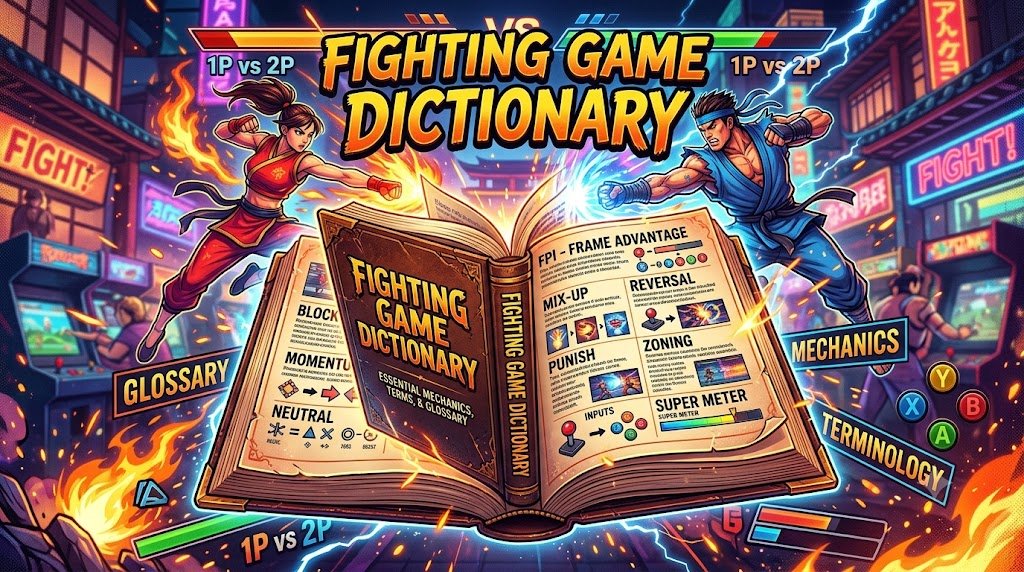
A fighting game dictionary can make learning games such as Street Fighter, Tekken, Mortal Kombat, and Guilty Gear much easier. Fighting game communities use specialized terms to describe attacks, movement, frame data, combos, defense, and strategy. If you are new to the genre, phrases like “whiff punish,” “plus frames,” or “meaty” can sound confusing at first.
This guide explains the most important fighting game terms in simple language. Whether you’re learning your first fighting game or trying to understand competitive discussions, you’ll find practical definitions, examples, and tips you can use during real matches.
Fighting Game Dictionary: Essential Terms Explained
Fighting games have their own vocabulary because players need quick ways to describe complex situations. The exact mechanics can vary between games, but many concepts appear across the genre.
Basic Fighting Game Terms
Start with these fundamental terms before moving into advanced concepts.
| Term | Meaning |
|---|---|
| Neutral | The stage of a match where neither player has a clear advantage. |
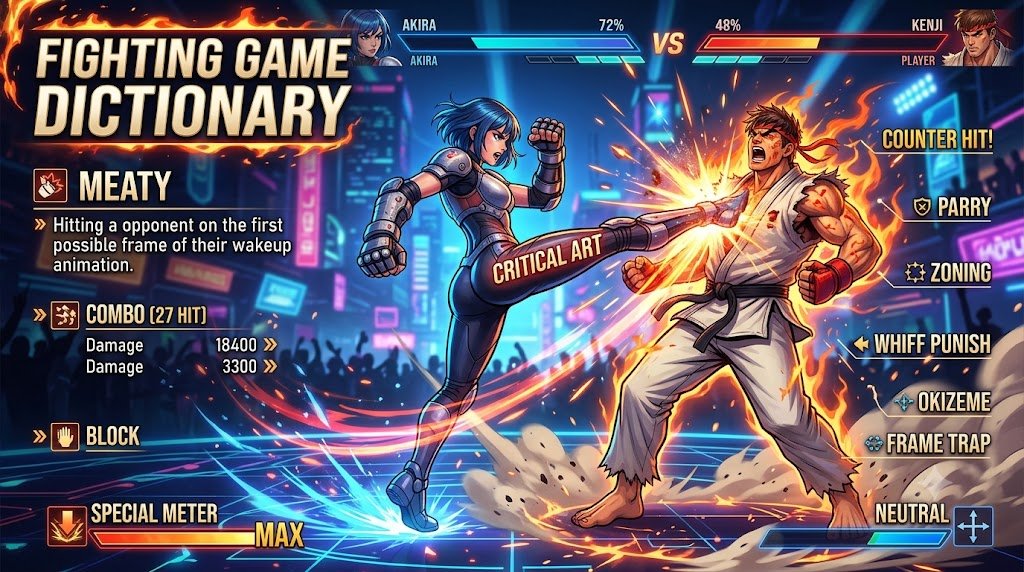
| Combo | A sequence of attacks that connect continuously. |
| Block | Defending against an incoming attack. |
| Punish | Attacking an opponent after they use a move that leaves them vulnerable. |
| Whiff | An attack that completely misses. |
| Footsies | Using movement, spacing, and attacks to control the area around your character. |
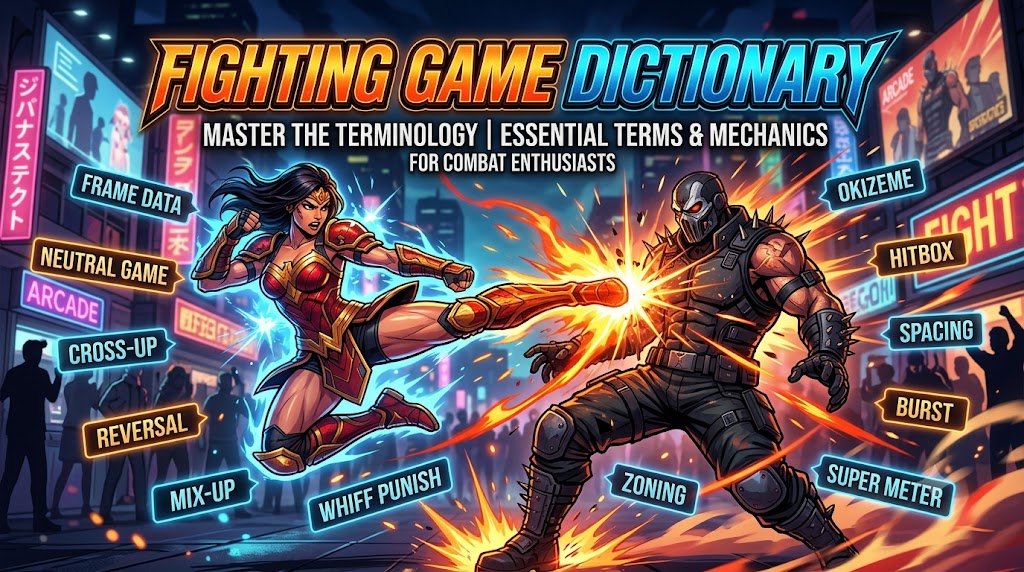
| Zoning | Keeping an opponent at a distance with projectiles or long-range attacks. |
| Rushdown | Applying aggressive pressure at close range. |
| Anti-air | An attack designed to stop an opponent who jumps toward you. |
| Reversal | An action performed immediately after recovering from a defensive situation, often to challenge pressure. |
Understanding these terms gives you a foundation for following tutorials, guides, tournament commentary, and community discussions.
What Is Neutral in Fighting Games?
Neutral describes a situation where neither player has established a strong offensive advantage.
During neutral, players usually compete for:
- Better positioning
- Attack range
- Stage control
- Information about the opponent
- Opportunities to start offense
For example, imagine two characters standing several steps apart. One player moves forward while the other backs away and looks for an opening. Neither player is currently attacking or blocking. This is a neutral situation.
Winning neutral often allows a player to begin pressure, start a combo, or force the opponent into a defensive position.
What Are Footsies?
Footsies refers to the spacing and movement game that happens around attack range.
A player might intentionally stand just outside an opponent’s attack range. If the opponent presses a button and misses, the player can quickly attack the exposed character.
This connects directly to whiff punishing.
Good footsies involve:
- Understanding attack ranges
- Controlling space
- Moving in and out of range
- Predicting the opponent’s attacks
- Using safe attacks to discourage movement
Despite the name, footsies are not limited to attacks involving a character’s feet.
Fighting Game Terms for Attacks and Combos
What Is a Combo?
A combo is a sequence of attacks that connect together without giving the opponent a normal opportunity to recover and defend between hits.
A simple combo might look like:
Light attack → medium attack → special move
Combos can vary dramatically in complexity. Some are easy to perform, while advanced combos may require precise timing, movement, resource management, or specific positioning.
What Is a Hit Confirm?
A hit confirm means checking whether an attack connected before committing to a larger combo or special move.
For example, a player might begin a short attack sequence. If the first attack hits, they continue into a combo. If it is blocked, they choose a safer option instead.
Hit confirms are valuable because they reduce unnecessary risks.
What Is a Counter Hit?
A counter hit generally occurs when your attack interrupts an opponent while they are attempting another attack.
Depending on the game, counter hits may provide:
- Extra damage
- Additional hit stun
- Special combo opportunities
- Different animations or effects
Always check the individual game’s rules because counter-hit properties differ.
Frame Data and Fighting Game Terminology
Frame data is one of the most important concepts in competitive fighting games.
What Are Frames?
Games display animation over individual frames. At common fighting-game frame rates, a frame represents a very small amount of time.
Players use frame data to understand how quickly attacks start, how long they remain active, and how vulnerable they are afterward.
Common terms include:
- Startup: Frames before an attack becomes active.
- Active: Frames during which the attack can hit.
- Recovery: Frames after the attack where the character cannot immediately act.
- Plus frames: The attacker can act sooner than the defender.
- Minus frames: The defender can act sooner.
- Frame advantage: The timing difference between two characters after an interaction.
Why Frame Data Matters
Suppose one attack leaves you at a significant frame disadvantage after being blocked. The opponent may have enough time to respond with a fast attack.
Knowing this helps players identify:
- Safe attacks
- Punishable moves
- Strong pressure options
- Guaranteed follow-ups
- Defensive opportunities
Frame data is especially useful when a move appears safe visually but is actually punishable.
Defense and Pressure Terms
What Is a Blockstring?
A blockstring is a sequence of attacks designed to keep an opponent blocking.
A good blockstring can create pressure while minimizing gaps that the defender can exploit.
Players may use blockstrings to:
- Force the opponent to keep blocking.
- Push the opponent toward the corner.
- Create a throw opportunity.
- End pressure safely.
- Create a potential mix-up.
What Is a Mix-Up?
A mix-up forces the defender to guess between different defensive options.
For example, an attacker might choose between:
- A high attack
- A low attack
- A throw
- A cross-up
- Waiting for the opponent to react
The exact options depend on the game.
Mix-ups are powerful because defending against one option may leave the player vulnerable to another.
What Is Oki?
Oki, short for okizeme, describes offensive pressure applied while an opponent is getting up or recovering from a knockdown.
A player might use this opportunity to:
- Attack
- Throw
- Set up a projectile
- Create a mix-up
- Control the opponent’s movement
Oki is especially important because a successful knockdown can give the attacking player another chance to maintain momentum.
Movement, Spacing, and Punishment
What Is a Whiff Punish?
A whiff punish happens when you attack an opponent immediately after their move misses.
Example:
- Your opponent uses a long-range attack.
- You step outside its range.
- Their attack misses.
- You quickly hit them during recovery.
The key is spacing and timing.
What Is Zoning?
Zoning is a strategy focused on controlling distance.
Zoning characters often use:
- Projectiles
- Long-range attacks
- Traps
- Space-controlling special moves
The goal is not simply to run away. Effective zoning controls where the opponent can safely move.
What Is Rushdown?
Rushdown is an aggressive style focused on staying close and continuously challenging the opponent.
Rushdown players often rely on:
- Fast attacks
- Pressure
- Mix-ups
- Throws
- Strong movement
- Knockdown setups
A rushdown strategy can overwhelm opponents who struggle under sustained pressure.
Advanced Fighting Game Terms
Once you understand the basics, these terms become easier to recognize.
Meaty
A meaty attack is timed to connect as an opponent is recovering from knockdown, often reducing their ability to challenge the attack immediately.
Anti-Air
An anti-air is an attack intended to stop an opponent from jumping toward you.
Punish
A punish occurs when you attack an opponent during the vulnerable recovery of their move.
Safe
A move is generally called safe when the opponent cannot reliably punish it after blocking.
Unsafe
An unsafe move leaves enough disadvantage for the opponent to respond with a reliable punish.
Cross-Up
A cross-up is an attack that makes the defender switch the direction in which they need to block, often by passing over the opponent.
Reversal
A reversal is commonly an action performed at the earliest possible opportunity after recovering from a knockdown, block situation, or other defensive state.
Fighting Game Terms by Skill Level
| Beginner | Intermediate | Advanced |
| Block | Frame advantage | Option select |
| Combo | Hit confirm | Fuzzy defense |
| Punish | Whiff punish | Meaty timing |
| Anti-air | Oki | Frame trap |
| Special move | Mix-up | Conditioning |
| Neutral | Pressure | Matchup knowledge |
Don’t feel pressured to memorize every advanced term immediately. Learning a smaller number of concepts and applying them correctly is more valuable than memorizing a long glossary.
Common Fighting Game Mistakes
New players often make the same mistakes when learning terminology and strategy.
Memorizing Terms Without Understanding Them
Knowing that “neutral” means a particular situation does not automatically make you better at neutral.
Try connecting each term to something you can recognize during an actual match.
Focusing Only on Combos
Combos are exciting, but they are only one part of fighting games.
A player can know difficult combos and still struggle because of:
- Poor defense
- Bad spacing
- Weak movement
- Predictable attacks
- Poor matchup knowledge
Ignoring Punishes
If an opponent repeatedly uses an unsafe move, learn how to punish it rather than simply blocking and resetting to neutral.
Using Unsafe Attacks Repeatedly
An attack that works once may stop working once your opponent understands its weaknesses.
Good players adapt.
How to Learn Fighting Game Terminology Faster
Use this simple process:
- Learn the basic vocabulary. Start with neutral, blocking, combos, punishes, and anti-airs.
- Choose one character. Learn their basic attacks and special moves.
- Practice one concept at a time. For example, focus on anti-airs during one training session.
- Watch experienced players. Listen for terms you recognize.
- Use training mode. Test which moves are safe, punishable, or useful at different ranges.
- Review your matches. Identify one repeated mistake instead of trying to fix everything at once.
- Learn matchup-specific terms later. Advanced vocabulary becomes easier once the fundamentals make sense.
5 Internal Link Opportunities for Retool Master
For a broader content strategy, consider linking this article to relevant Retool Master pages using natural anchor text such as:
- fighting game basics — link to a beginner’s guide.
- fighting game mechanics — link to an article explaining core mechanics.
- how to improve at fighting games — link to a training or improvement guide.
- competitive gaming terminology — link to a broader gaming glossary.
- best fighting games for beginners — link to a game recommendation guide.
3 Authoritative External Sources to Consider
For additional credibility, consider linking readers to established sources such as:
- Capcom — useful for official information about Street Fighter and its game systems.
- Bandai Namco Entertainment — useful for official Tekken information.
- EVO — useful for competitive fighting game tournament information and the broader fighting game community.
Use the specific official pages that directly support the surrounding claim rather than adding external links simply for SEO.
FAQ: Fighting Game Dictionary
What is a fighting game dictionary?
A fighting game dictionary is a glossary that explains common terminology used in fighting games, including neutral, combos, frame data, zoning, pressure, punishes, and mix-ups.
What does neutral mean in a fighting game?
Neutral describes a situation where neither player has a clear offensive advantage. Players use movement, spacing, attacks, and prediction to gain control.
What does “whiff” mean in fighting games?
A whiff occurs when an attack misses the opponent completely. Players can sometimes punish the recovery of a whiffed attack.
What is a punish in fighting games?
A punish is an attack performed after an opponent uses a move that leaves them vulnerable. The defender takes advantage of the move’s recovery or disadvantage.
What does frame data mean?
Frame data describes the timing properties of moves, including startup, active frames, recovery, and advantage or disadvantage after an interaction.
What is zoning in a fighting game?
Zoning is a strategy based on controlling distance and limiting an opponent’s ability to approach safely, often through projectiles or long-range attacks.
What does rushdown mean?
Rushdown is an aggressive playstyle focused on staying close to the opponent and applying continuous pressure through attacks, movement, throws, and mix-ups.
What is a hit confirm?
A hit confirm is the process of checking whether an attack connected before committing to a larger combo or attack sequence.
What is oki in fighting games?
Oki refers to offensive pressure applied around an opponent’s wake-up or recovery after being knocked down.
What is a cross-up?
A cross-up is an attack that changes the defender’s required blocking direction, often by attacking while moving across the opponent.
Conclusion
Learning fighting game terminology makes guides, tutorials, tournament commentary, and matches much easier to understand. The most important concepts to start with are neutral, blocking, combos, punishes, footsies, frame data, pressure, zoning, and mix-ups. Once these ideas become familiar, advanced concepts such as oki, frame traps, conditioning, and matchup-specific strategies become much easier to learn.
Keep this fighting game dictionary as a reference while you practice. Instead of trying to memorize everything at once, choose a few terms, identify them in real matches, and apply them in training mode. For more practical gaming guides and helpful explainers, explore the resources available from Retool Master.














No Comments