


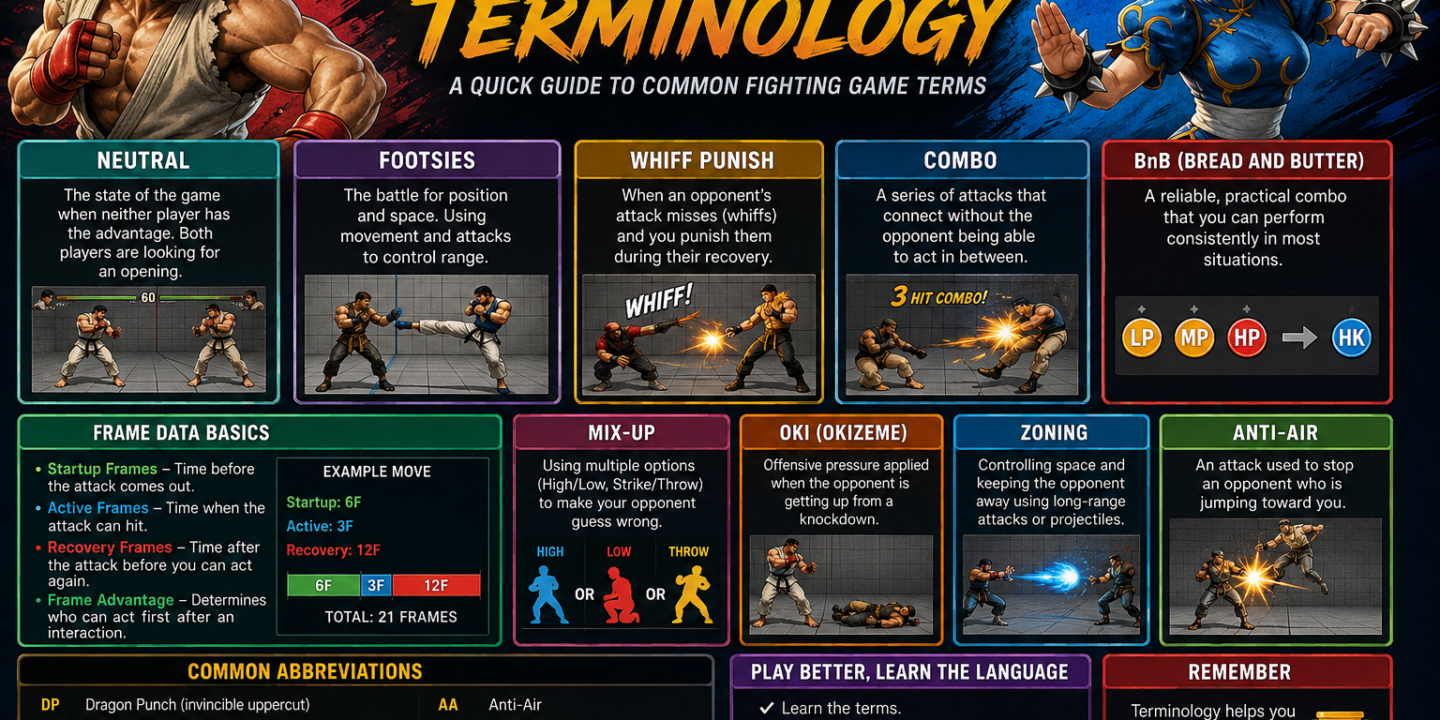
Fighting Game Terminology can feel like a language of its own. Words such as neutral, footsies, whiff punish, oki, frame trap, and BnB may sound confusing when you first watch experienced players discuss games like Street Fighter, Tekken, Mortal Kombat, or Guilty Gear. Once you understand the basic vocabulary, however, strategy guides, tournament commentary, and in-game discussions become much easier to follow.
This guide explains the most common fighting game terms in simple language. You will learn what players mean by neutral, combos, frame data, pressure, zoning, mix-ups, punishes, and more. The goal is not just to memorize definitions, but to understand how these terms describe what actually happens during a match.
What Is Fighting Game Terminology?
Fighting game terminology is the collection of words, abbreviations, and phrases players use to describe attacks, movement, strategy, combos, defense, and match situations.
Some terms are shared across many games, while others are specific to particular franchises. For example, BnB is widely used to describe a character’s reliable basic combo, while terms such as DP often come from a specific type of motion or move associated with certain fighting games.
Because each game has its own mechanics, the exact meaning or application of a term can sometimes vary.
Core Fighting Game Terms Every Beginner Should Know
Neutral
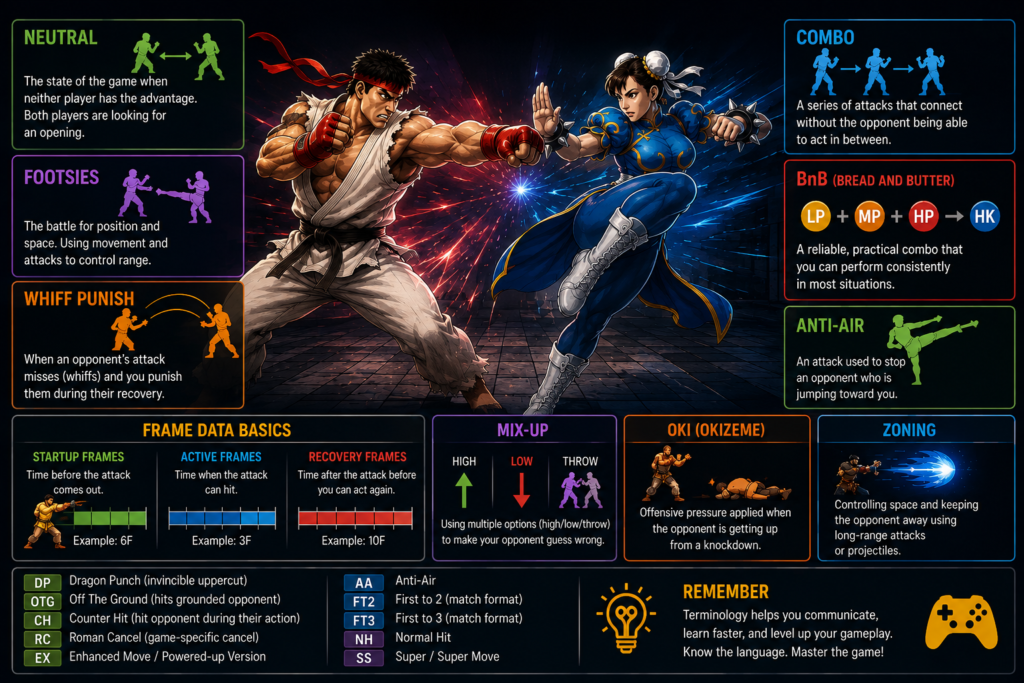
Neutral describes a situation where neither player has a clear advantage and both are looking for an opportunity to attack.
During neutral, players may:
- Move into or out of attack range
- Look for an opening
- Throw out attacks
- Block or defend
- Try to make the opponent miss
- Look for a jump or approach
Winning neutral often gives a player the opportunity to start pressure or a combo.
Footsies
Footsies refers to the battle for advantageous positioning and attack range, especially when both players are trying to control the space between them.
A player might use a long-reaching normal attack to stop an opponent from approaching. If that attack misses, the other player may whiff punish it.
Whiff
A whiff occurs when an attack is performed but does not connect with the opponent.
For example, if a player attacks from too far away and the opponent is outside the move’s range, the attack whiffs.
Whiff Punish
A whiff punish happens when you attack an opponent after they miss a move, taking advantage of the recovery period.
This is an important part of neutral because repeatedly attacking without considering range can give the opponent easy opportunities to punish.
Combo and Attack Terminology
Combo
A combo is a sequence of attacks that connect together under the game’s rules, usually without allowing the opponent to act between hits.
Combos can range from simple two-hit sequences to long, technically demanding routes.
BnB Meaning in Fighting Games
BnB means Bread and Butter. A BnB combo is a reliable, commonly used combo that a player can perform consistently in normal situations.
When someone asks for the BnB meaning fighting games players usually mean the standard combo a character uses as a basic, dependable option.
A good BnB is often:
- Practical
- Consistent
- Easy enough to perform regularly
- Useful in common situations
- A good starting point for learning a character
Link
A link connects two attacks by timing the second attack after the first one has recovered enough for another move to connect.
Links usually require precise timing.
Cancel
A cancel occurs when one move is interrupted by another move under the game’s mechanics, allowing the player to transition directly into the next action.
Blockstring
A blockstring is a sequence of attacks designed to keep an opponent blocking.
A strong blockstring can create pressure while limiting the opponent’s immediate opportunities to respond.
Frame Data Explained
Frame data is one of the most important parts of advanced fighting game vocabulary.
Startup Frames
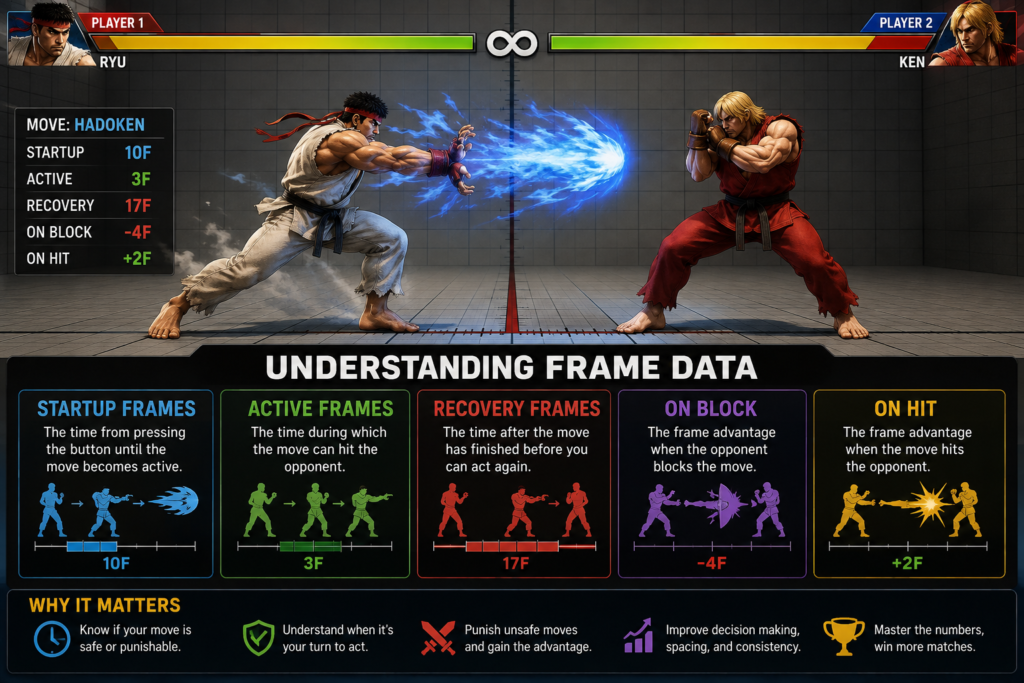
Startup refers to the frames before an attack becomes capable of hitting the opponent.
A move with fewer startup frames generally becomes active more quickly than one with more startup frames.
Active Frames
Active frames are the frames during which an attack can actually connect with an opponent.
Recovery Frames
Recovery is the time after the active portion of an attack before the character can return to normal actions.
Frame Advantage
Frame advantage describes the difference in timing between two players after an interaction.
For example, if one character recovers before the opponent, that character may be able to act first and continue pressure.
Frame data is especially useful when deciding which attacks are safe, punishable, or suitable for starting combos. Community resources such as SuperCombo Wiki provide detailed game-specific frame-data information.
Defense and Punishment Terms
Block
Blocking is a defensive action used to prevent or reduce damage from incoming attacks, depending on the game’s mechanics.
Different games may have different blocking systems.
Punish
A punish happens when you hit an opponent after they use an attack or action that leaves them vulnerable.
For example, if an opponent uses a move with long recovery and you block it, you may have enough time to respond with your own attack.
Safe and Unsafe
A safe move generally cannot be punished easily after being blocked.
An unsafe move leaves the attacker vulnerable enough for the defender to retaliate.
The exact definition depends on the game’s frame data and mechanics.
Reversal
A reversal generally refers to performing an action immediately after recovering from a disadvantaged situation, such as getting up from a knockdown.
Some games specifically use the term for attacks or special moves performed with very precise timing.
Mix-Ups, Throws, and Pressure
Mix-Up
A mix-up forces the opponent to choose between multiple defensive options.
Common examples include:
- High vs. low
- Strike vs. throw
- Left vs. right
- Throw vs. shimmy
- Different attack timings
The goal is to make the defender guess incorrectly.
Throw
A throw is an attack designed to grab an opponent, often bypassing normal blocking.
Many fighting games include specific mechanics for escaping or breaking throws.
Shimmy
A shimmy is a movement or timing technique designed to make an opponent expect a throw and then punish their defensive response.
It is commonly associated with strike/throw mind games.
Oki
Oki, short for okizeme, describes offensive pressure applied when an opponent is getting up after being knocked down.
A player may use this situation to threaten a throw, strike, low attack, or another option.
Zoning and Rushdown
Zoning
Zoning is a strategy based on controlling space and keeping the opponent at an advantageous distance.
Zoning characters may use:
- Projectiles
- Long-range attacks
- Traps
- Space-control tools
The goal is usually to control where the opponent can safely move.
Rushdown
Rushdown is an aggressive playstyle focused on quickly approaching the opponent and maintaining offensive pressure.
Rushdown characters often rely on:
- Fast attacks
- Mobility
- Mix-ups
- Strong pressure
- Close-range offense
Grappler
A grappler is generally a character whose game plan emphasizes powerful throws or command grabs, often balanced by slower movement or different neutral tools.
Important Movement and Hitbox Terms
Hitbox
A hitbox is the area associated with an attack that can connect with an opponent.
Hurtbox
A hurtbox is the area where a character can be affected by attacks.
The relationship between hitboxes and hurtboxes helps explain why some attacks connect from surprising distances while others miss.
Cross-Up
A cross-up is an attack designed to make the defender uncertain about which direction they should block, often by attacking from the opposite side during an airborne approach.
Anti-Air
An anti-air is an attack or defensive option used to stop an opponent who is jumping toward you.
Anti-airs are especially important in games where jumping attacks are a major part of neutral.
Fighting Game Abbreviations You Will See Often
| Term | Meaning | Simple Explanation |
|---|---|---|
| BnB | Bread and Butter | Reliable basic combo |
| DP | Dragon Punch | Common shorthand for certain uppercut-style moves |
| OTG | Off the Ground | Attack that can hit a grounded opponent |
| Oki | Okizeme | Pressure after a knockdown |
| CH | Counter Hit | Attack that lands during a vulnerable action |
| RC | Roman Cancel / game-specific cancel | A cancel mechanic in some games |
| DoT | Damage over Time | Recurring damage in games that support it |
| EX | Enhanced version | Powered-up special move in some games |
| AA | Anti-Air | Tool used against jumping opponents |
| FT2 | First to 2 | First player to win two games |
| FT3 | First to 3 | First player to win three games |
Tournament terminology can also vary by event and game. For example, Evo defines a game as an individual head-to-head competition and a set as the series used to determine the winner between competitors.
How to Learn Fighting Game Vocabulary Faster
You do not need to memorize an entire fighting game dictionary before playing.
Try this approach:
- Learn basic attack terms first. Understand normals, specials, throws, and blocks.
- Learn neutral concepts. Focus on spacing, footsies, whiffing, and punishing.
- Study frame basics. Learn startup, active, recovery, and frame advantage.
- Learn your character’s BnB. Start with one reliable combo.
- Watch gameplay. Listen for terminology used by commentators and experienced players.
- Practice one concept at a time. Do not try to master everything during one session.
- Check game-specific resources. Terminology and mechanics can differ between franchises.
The SuperCombo Wiki describes itself as a repository for fighting game strategy knowledge, making it a useful community reference for learning game-specific systems and terminology.
Common Fighting Game Terminology Mistakes
Confusing a Combo With a Blockstring
A combo connects without giving the opponent a normal opportunity to act between attacks. A blockstring is designed to keep an opponent blocking.
Assuming Every Term Works the Same Way
A term may have a slightly different application depending on the game.
Focusing Only on Combos
Combos matter, but strong fundamentals such as spacing, defense, neutral, anti-airs, and punishment are equally important.
Ignoring Frame Data
You do not need to memorize every number, but understanding basic frame concepts can help explain why certain moves work or fail.
How Fighting Game Terminology Helps You Improve
Learning vocabulary is more than learning slang. It gives you a way to describe problems.
Instead of saying:
“That move keeps beating me.”
You can ask:
- Is the move plus on block?
- Can I punish it?
- Am I getting caught by a frame trap?
- Is my spacing too close?
- Can I whiff punish it?
- Do I have an anti-air?
- Am I losing the throw/strike mix-up?
These questions make practice more focused and useful.
Internal Linking Opportunities
For a Retool Master website, consider linking this article naturally to:
- Best Fighting Games for Beginners
- How to Learn Fighting Games
- Fighting Game Combos Explained
- What Is Frame Data in Fighting Games?
- Best Fighting Game Characters for New Players
These links can help build a stronger topical cluster around fighting games and improve navigation for readers.
Authoritative External Linking Opportunities
Consider linking readers to these established resources:
- Evo Rules — useful for tournament terminology and competitive formats.
- SuperCombo Wiki — useful for game-specific terminology, strategy, and frame-data references.
- Official game documentation or training resources — use the official website for the specific fighting game being discussed, especially when explaining game-specific mechanics.
Frequently Asked Questions
What is fighting game terminology?
Fighting game terminology is the vocabulary players use to describe attacks, movement, combos, defense, strategy, frame data, and competitive situations.
What does BnB mean in fighting games?
BnB means Bread and Butter. It usually describes a reliable, practical combo that a character can use frequently in common situations.
What does neutral mean in fighting games?
Neutral is the situation where neither player has a clear offensive advantage and both are trying to gain a favorable position or create an opening.
What are footsies in fighting games?
Footsies refers to spacing and neutral interactions where players use movement, attacks, and positioning to control range and create opportunities.
What does whiff mean in fighting games?
A whiff occurs when an attack misses because it does not connect with the opponent.
What is a whiff punish?
A whiff punish happens when you attack an opponent after their move misses, taking advantage of the recovery period.
What does oki mean in fighting games?
Oki, or okizeme, refers to offensive pressure applied as an opponent recovers from a knockdown.
What is a frame trap?
A frame trap is an offensive sequence designed to encourage the opponent to attempt an action and then catch that action with a follow-up attack.
What is zoning in fighting games?
Zoning is a strategy focused on controlling space and maintaining a favorable distance from the opponent, often through projectiles or long-range attacks.
Why is frame data important?
Frame data helps players understand how quickly moves start, how long they remain active, how much recovery they have, and whether one player can act before the other.
Conclusion
Learning Fighting Game Terminology makes competitive games much easier to understand. Terms such as neutral, footsies, BnB, frame data, whiff punish, oki, zoning, rushdown, and mix-up give players a shared language for discussing strategy and improving their gameplay.
You do not need to memorize every term at once. Start with the fundamentals, practice them in your chosen game, and gradually expand your vocabulary as you encounter new situations.
Ready to Improve Your Fighting Game Knowledge?
At Retool Master, the goal is to make complicated gaming concepts easier to understand. Keep exploring practical guides, learn the terminology behind the mechanics, and turn confusing fighting game jargon into useful knowledge you can apply in your next match.










No Comments