


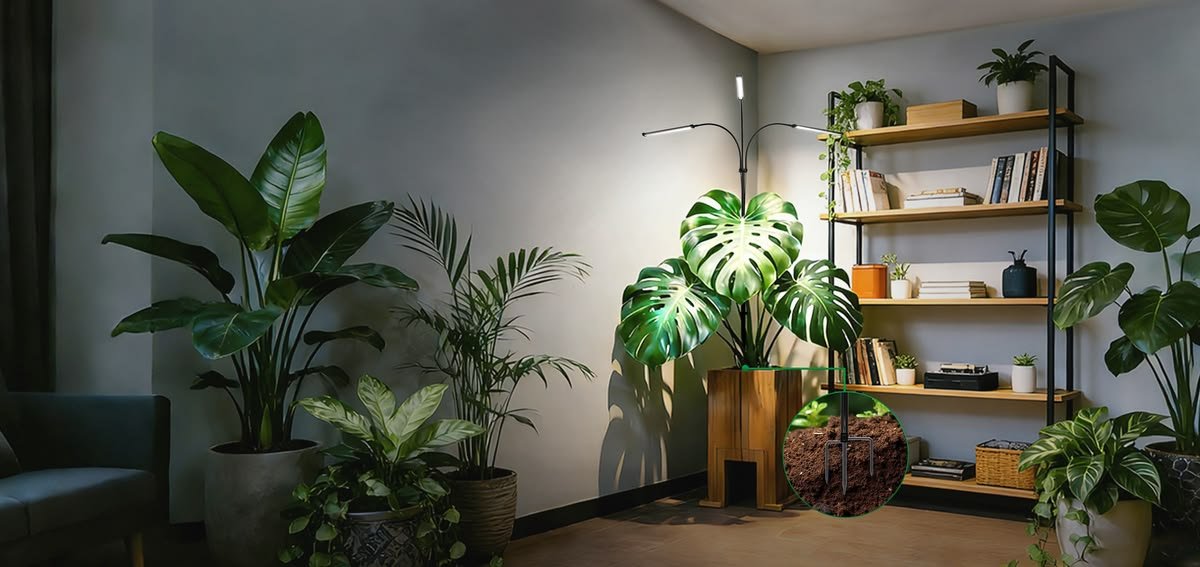
Finding the best lights for growing plants indoors can make the difference between healthy, compact growth and plants that become weak, pale, or stretched. Natural sunlight is not always enough, especially in rooms with small windows, shaded spaces, or during shorter winter days.
The good news is that you do not need a complicated indoor growing setup. A suitable LED grow light, the correct distance, and a consistent lighting schedule can provide supplemental light for many houseplants, herbs, and seedlings. University of Minnesota Extension notes that supplemental lighting can make up for insufficient natural sunlight, while LED lights offer efficiency, long life, and a wide range of sizes and styles.
This guide explains what to look for, how long to run your lights, how far to place them from plants, and which features actually matter.
What Are the Best Lights for Growing Plants Indoors?
For most home growers, LED grow lights are the best all-around choice for growing plants indoors. They are energy efficient, available in different sizes, produce relatively little heat, and can provide a broad spectrum suitable for many plants.
A good indoor plant light should provide:
- Adequate light intensity
- A plant-friendly spectrum
- Even coverage
- Adjustable positioning
- A suitable operating schedule
- Low enough heat for the growing space
- A convenient timer or timer compatibility
There is no single perfect light for every plant. A low-light pothos has very different requirements from tomato seedlings or flowering plants.
Why LED Grow Lights Are a Strong Choice
LEDs have become a practical option for home growers because they combine efficiency with flexibility. They are available as bulbs, panels, strips, bars, and adjustable lamps.
They are particularly useful when:
- Your room has little natural sunlight
- Plants are far from windows
- You are starting seeds indoors
- You want to grow herbs year-round
- Your plants need supplemental light during winter
- You want consistent lighting each day
University of Minnesota Extension lists LEDs as energy efficient, long-lasting, relatively low-heat, and available in many styles and sizes.
LED vs. Fluorescent vs. Incandescent Grow Lights
LEDs are not the only option, but they are usually the most convenient choice for modern indoor growing.
| Light Type | Best For | Main Advantage | Main Drawback |
|---|---|---|---|
| LED | Most indoor plants | Efficient and versatile | Higher initial cost |
| Fluorescent | Seedlings and foliage | Affordable and proven | Less efficient than LEDs |
| Incandescent | Generally not recommended | Low purchase price | Inefficient and produces heat |
| High-pressure sodium | Large growing areas | High light output | Heat, size, and energy use |
Fluorescent lighting can still work well for some indoor plants and seedlings. However, incandescent bulbs are generally a poor choice because they produce substantial heat and are inefficient for plant lighting.
Full-Spectrum vs. Red and Blue Grow Lights
You will often see grow lights described as full-spectrum, balanced, red, or blue.
Plants use different wavelengths of light during photosynthesis. Red and blue portions of the spectrum are particularly important, while balanced or white grow lights can provide a broader range of usable wavelengths.
Full-Spectrum Lights
For most home growers, a white or full-spectrum LED is the easiest option.
They are useful for:
- Houseplants
- Herbs
- Seedlings
- Leafy greens
- Flowering plants
- Mixed plant collections
They also make it easier to see the natural color of your plants compared with some intensely colored red-and-blue fixtures.
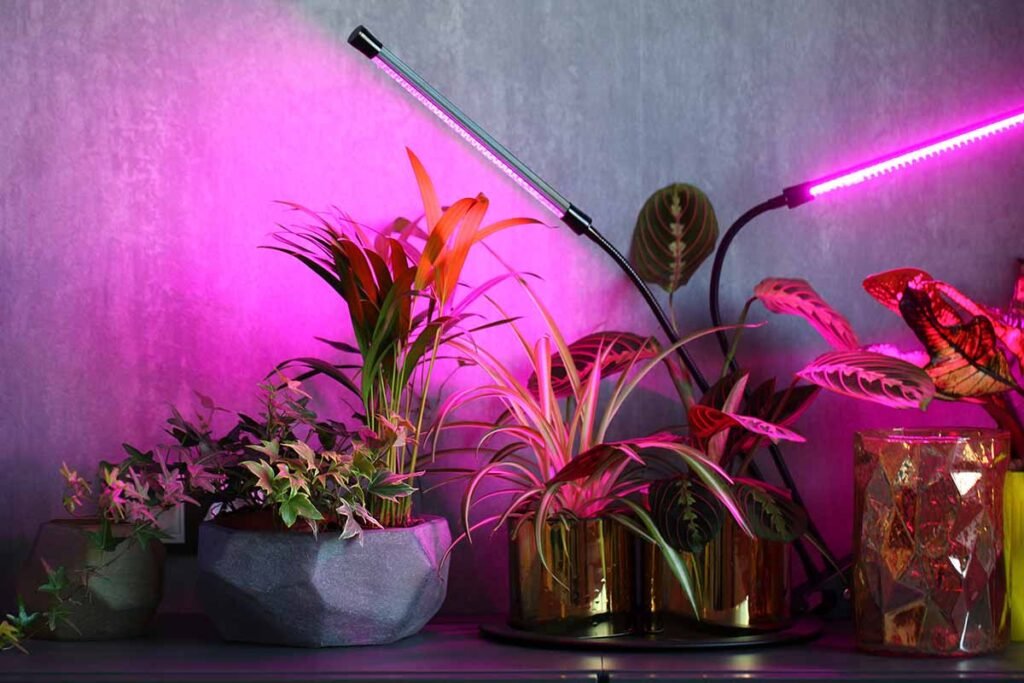
Red and Blue Lights
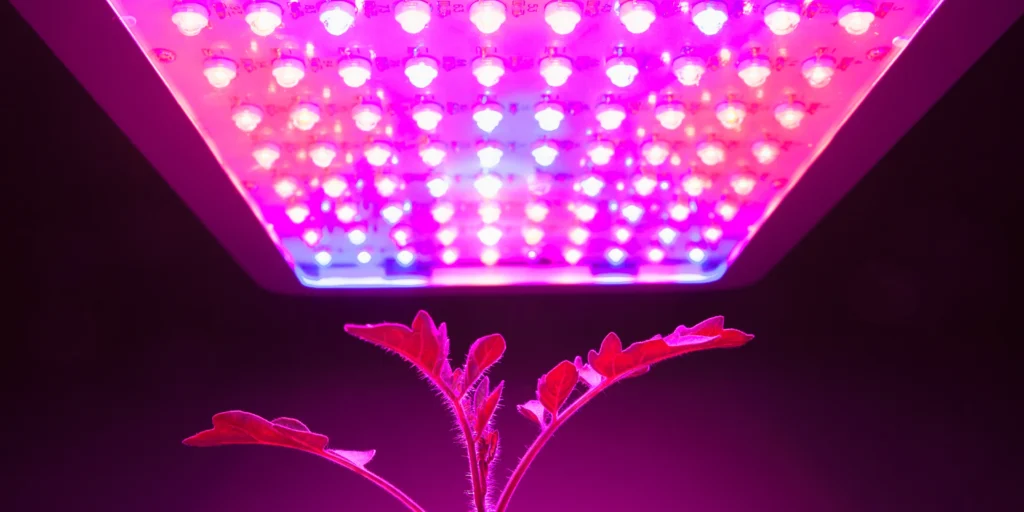
Blue-rich lighting can support vegetative growth, while red wavelengths play an important role in flowering and fruit production. However, buying separate red and blue lights is not necessary for most casual indoor gardeners.
A balanced light designed for plant growth is generally a simpler choice.
How Bright Should an Indoor Grow Light Be?
One of the biggest mistakes is choosing a light based only on wattage.
Watts measure electrical power, not how much useful plant light reaches the leaves. For plant lighting, measurements such as PPF and PPFD can provide more useful information. PPFD describes the amount of photosynthetically active light reaching a surface such as a plant leaf.
When comparing lights, look for:
- PPFD: Useful for understanding light reaching the plant.
- PPF: Indicates the amount of plant-usable light produced by the fixture.
- Coverage area: Shows how much space the light can effectively illuminate.
- Wattage: Useful for energy consumption, but not sufficient for judging plant performance.
Do not assume that a higher-wattage bulb is automatically better.
How Far Should Grow Lights Be From Plants?
Distance matters because light intensity decreases as the plant moves farther from the light source.
As a general starting point, University of Minnesota Extension gives these approximate distances:
- Seedlings: 4–6 inches
- Hydroponic lettuce and herbs: 6–12 inches
- Foliage houseplants: 12–24 inches
- Flowering houseplants: 6–12 inches
These are starting guidelines, not universal rules. Always consider the manufacturer’s instructions and observe how your plants respond.
If plants become stretched and lean toward the light, they may need more light. If leaves become bleached or scorched, the light may be too intense or too close.
How Many Hours Should Grow Lights Stay On?
Plants need both light and darkness. Leaving a grow light on continuously is not a good general practice.
University of Minnesota Extension recommends different schedules depending on the plant:
| Plant Type | Approximate Light Period |
| Seedlings | 16–18 hours/day |
| Hydroponic lettuce and herbs | 12–14 hours/day |
| Foliage houseplants | 12–14 hours/day |
| Flowering houseplants | 14–16 hours/day |
A simple plug-in timer can automate the schedule and keep lighting consistent.
Pro Tip: Use Natural Light as Supplemental Light
You do not always need to replace sunlight completely.
For example, a plant sitting beside a bright window may only need artificial lighting to fill in the weaker parts of the day. In darker rooms, the grow light may need to provide most of the plant’s usable light.
Best Grow Lights for Different Indoor Plants
Best Lights for Houseplants
For common foliage plants such as pothos, philodendrons, spider plants, and snake plants, a balanced LED grow light is usually a practical choice.
Low-light plants can tolerate less illumination, but additional light may encourage denser growth.
Best Lights for Seedlings
Seedlings need consistent, strong light to prevent thin, elongated growth. LED fixtures or suitable fluorescent lights can work well.
Keep the light close enough to provide sufficient intensity, and raise it as the plants grow. University of Minnesota Extension recommends keeping seedling lights very close to the plant tops and using a timer for consistent daily lighting.
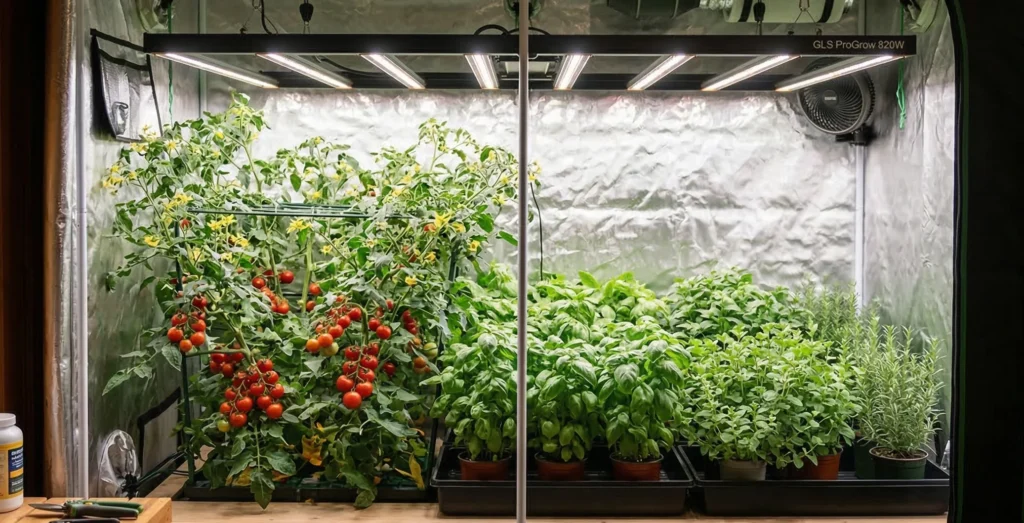
Best Lights for Herbs and Edible Plants
Basil, thyme, and other culinary herbs generally need brighter conditions than many low-light houseplants. A strong LED grow light can be useful when a sunny window is unavailable.
Most importantly, provide enough intensity and a consistent schedule rather than simply choosing the bulb with the highest wattage.
Best Lights for Flowering Plants
Flowering plants generally require higher light levels than many foliage plants. Red wavelengths are especially relevant to flowering, but a balanced grow light can be suitable for many home setups.
Common Indoor Grow Light Mistakes
Avoid these common problems:
- Choosing by watts alone: Wattage does not tell you how much plant-usable light reaches the leaves.
- Placing the light too far away: The plant may receive insufficient intensity.
- Keeping lights on 24/7: Plants need a dark period.
- Ignoring coverage: One small bulb may not illuminate an entire shelf evenly.
- Using incandescent bulbs: They can produce excessive heat and are inefficient for plant growing.
- Ignoring the plant’s needs: A cactus, seedling, and pothos do not necessarily require the same lighting.
- Never adjusting the fixture: Plants grow, so the distance may need to change.
How to Tell If Your Plants Need More Light
Your plant can provide useful clues.
Signs of insufficient light may include:
- Long, thin stems
- Large spaces between leaves
- Leaning toward the light
- Pale or yellowing foliage
- Slow growth
- Failure to flower
However, these symptoms can have other causes, so do not assume lighting is always the problem. Watering, nutrients, pests, temperature, and root health should also be considered.
A Simple Indoor Grow Light Setup
You can create an effective setup without complicated equipment.
- Identify the plant’s light requirements.
- Check how much natural light the location receives.
- Choose an LED grow light with suitable coverage.
- Position the light according to its output and the plant type.
- Use a timer for consistent lighting.
- Watch the plant for signs of too little or excessive light.
- Adjust the height as the plant grows.
This approach is usually more effective than simply buying the brightest fixture available.
Internal Linking Opportunities
Consider adding these internal links within the Retool Master website:
- how to care for indoor plants — Link from the general lighting section.
- best plants for low-light rooms — Link from the low-light plant discussion.
- indoor gardening tips for beginners — Link from the setup section.
- how often should you water houseplants — Link from the troubleshooting section.
- best indoor plants for home offices — Link from the houseplant recommendations.
Authoritative External Sources
For additional credibility and reader value, consider linking to:
- University of Minnesota Extension: Lighting for Indoor Plants and Starting Seeds
- University of Illinois Extension: Houseplant Lighting
- Penn State Extension: Low-Light Houseplants
Frequently Asked Questions
1. What are the best lights for growing plants indoors?
For most home growers, LED grow lights are an excellent choice because they are efficient, long-lasting, versatile, and available in different sizes and spectrums.
2. Are LED lights good for indoor plants?
Yes. LED grow lights can provide suitable supplemental lighting for houseplants, seedlings, herbs, and many flowering plants when properly positioned and scheduled.
3. Is full-spectrum light better for plants?
A balanced or full-spectrum light is a convenient option because it provides a broad range of wavelengths suitable for many types of plants and growth stages.
4. How many hours should a grow light be on?
It depends on the plant. Many foliage houseplants need around 12–14 hours of supplemental light, while seedlings may need approximately 16–18 hours. Plants also need a period of darkness.
5. How far should an LED grow light be from plants?
It depends on the fixture and plant. As a starting point, foliage plants may be around 12–24 inches away, while seedlings often need much closer lighting. Always check the manufacturer’s guidance and monitor the plant.
6. Can regular LED bulbs grow plants?
Some regular LED bulbs can provide useful supplemental light, but plant-specific LEDs are generally easier to evaluate because they are designed around plant-lighting needs.
7. Are grow lights necessary for houseplants?
Not always. A bright window may provide sufficient light for some plants. Grow lights become especially useful when natural light is weak, inconsistent, or unavailable.
8. What color grow light is best for indoor plants?
A balanced or full-spectrum white light is a practical choice for most home growers. Red and blue wavelengths are important to plant growth, but a broad-spectrum fixture can simplify the setup.
9. Can grow lights burn indoor plants?
Yes, excessive light or excessive heat can damage foliage. If leaves become bleached, scorched, or unusually stressed, check the light’s intensity, distance, and operating time.
10. Should I use a timer with my grow light?
Yes. A timer makes it easier to maintain a consistent lighting schedule and ensures plants receive a regular dark period.
Conclusion
Choosing the best lights for growing plants indoors is less about finding the most powerful bulb and more about matching light quality, intensity, coverage, distance, and duration to your plants. For most home growers, a suitable LED grow light is a practical starting point.
Begin by identifying your plant’s light requirements, then choose a fixture that provides appropriate coverage and usable light. Position it correctly, use a timer, and watch your plants for signs of too little or too much light. With the right setup, even a room without ideal sunlight can become a productive indoor growing space.
Call to Action
Want more practical guidance for creating a healthier, more functional home growing setup? Explore Retool Master for helpful guides, ideas, and resources designed to make everyday home projects easier to understand and put into practice.














No Comments